

My name is Cody Cockrum. I was born in Reno, Nevada in the United States of America in 1984 to loving parents. I have an older sister. I had a great childhood. I grew up as a middle-class kid, living in a nice, new, safe part of town, and I cared more about skateboarding and riding dirt bikes than school. I rarely paid attention to politics or even the current events of the time. I just wanted to have fun, work whatever menial job I had to make a little extra money to spend on dirt bike parts or gear. I didn’t care what was happening somewhere else. It didn’t ever seem to impact my life, so I remained ignorant to it.
Then, when I was 17 years old, in the 12th grade, I remember my father coming to wake me up on September 11th, 2001. It was earlier than I normally needed to wake up to make it to school on time, so I was in no hurry. My father came into my room to wake me up again, and this time he said “Get up. We’re going to war.”
I walked out to the living room where my father had the news on the television. The first plane had already hit one of the World Trade Center buildings, and I watched in disbelief as the second plane flew into the other. I watched my fellow countrymen jumping from the buildings to avoid being burned to death.
I went to school that day, but nobody was teaching. The classrooms just had TVs turned on and tuned to the news, where we all watched the events continue to unfold. The 3rd plane crashing into the Pentagon, the collapse of 3 World Trade Center buildings, and the deaths of thousands of Americans.
I had never really considered joining the military until that day. But I waited. The timing never seemed right. Finally, when I was 23, in 2007, I realized there would be no “right time,” and decided to join the Army to become an Airborne Infantryman so I could go fight with my countrymen and serve my nation.
I deployed to Afghanistan in March of 2009, and spent a year conducting presence patrols, reconnaissance missions, direct action missions, kill/capture missions, raids on enemy homes and compounds, training the Afghan National Army, making friends with the locals, and other, more menial tasks, like guarding our outpost from a tower, controlling the entrance to our outpost, and improving the condition of our outpost.
As an US Army member when you were in Afghanistan, what did you witness and experience there?
There was so much to take in. It was a total culture shock for me. Having been born to a normal middle-class family in the United States, and never really experiencing true financial, emotional, or physical hardship, it really changed my perspective. Within about a month, I learned what real poverty looks like, what real emotional turmoil felt like, and really witnessed how much different life can be, depending simply where you are born.
When my unit first got to Afghanistan, we arrived first as Bagram, stayed there for a couple of days waiting for a flight to FOB Sharana, our Battalion Headquarters outpost. It was a large outpost comparatively speaking, and we stayed in large, heated tents there for almost a month while we received and prepared our armored Humvee and MRAP (Mine Resistant, Ambush Protected) vehicles to drive about 40 Kilometers South to our much, much smaller, and remote platoon outpost in a place called Wazah Khwah.
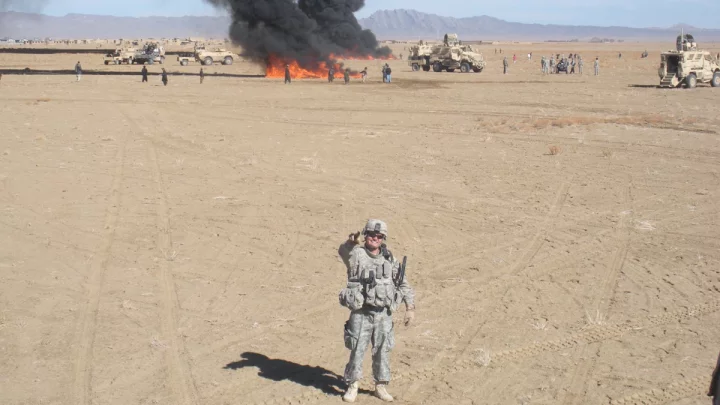
The platoon movement to Wazah Khwah was when the reality of where we were and what we were doing finally really set in. The movement was only supposed to take us a few days across various terrain and villages, none of it paved, of course. There was apparently only one dirt road through leading south through a valley that was known to have heavy Taliban presence. Our platoon was escorting many civilian trucks and vehicles bringing supplies to the area we were heading to, in Paktika Province, but they were afraid of this particular pass because of the Taliban presence.
As soon as we started moving through the pass, our lead vehicle hit an Improvised Explosive Device (IED). We recovered the remains of the vehicle as best as we could and began moving again. We made it maybe 100m or so, and the lead vehicle hit another IED. We recovered the vehicle, began moving, and hit another IED. And then another, and another, and another. It was terrible. It was terrifying. Any time we moved, any direction we moved, it seemed like there was an IED there. During the recovery of a vehicle – about 14 or 15 bombs in – the civilians that were in a vehicle in front of me were apparently frustrated and tired of sitting in their truck, and they jumped out with a ball and started kicking it around. One of the four men stepped on a secondary IED that was emplaced for just this kind of reason. To kill or maim anyone who may be getting out of their vehicle to go help the front vehicle. The man that stepped on that IED essentially disappeared from the blast, instantly killed. Another man was alive, but very badly injured, and he died after only a couple of minutes. A third man was injured badly, as well, but was conscious and aware of what had happened. He, too, died after a few more minutes, despite our efforts to save him. A fourth man was injured badly but walking around and speaking. When I looked over toward him, it appeared his entire face had been blown off, and he was burned and bleeding from lacerations all over his body. I believe he was in shock. We were able to keep him alive long enough for a Medical Evacuation helicopter to get him, but I’m not sure if he lived beyond that.
The movement took over two weeks. The Taliban had figured out that we were coming and emplaced enough IEDs to destroy many of our vehicles, a US Army unit conducting Route Clearance lost most of their vehicles and sustained some casualties. We were attacked while recovering a vehicle that had been blown up and had caught fire and burned, and an Afghan civilian was shot in the leg, treated by our Medic, and evacuated out.
Throughout the course of the rest of my deployment, we would regularly visit different villages, either on foot, or by vehicle when we could, and try to speak with the locals and the village elders about how they felt about the Taliban, how they felt about us and our presence, as if there were any needs that we may be able to help supply, offer basic medical attention when possible, and give out toys, candy, drinks, radios, and food to the children.
Sometimes the villages we visited were extremely welcoming and warm and kind to us. They would tell us about how they are afraid of the Taliban coming to their village and hurting or killing people, they would give us intel about where and when they saw Taliban last, etc. Sometimes the villages we visited were hostile and did not want us anywhere near them. Sometimes, we would visit a village like this, and notice people on phones. If we let them know where we planned on going next, we would be attacked after leaving. The villagers were obviously in contact with the Taliban and relaying our plans and location. We would visit these unfriendly villages at times, and purposely let them know where we were heading just to draw the Taliban out into a firefight, so we could kill them and destroy their fighting positions.
We were sometimes offered food, always offered chai, we cleared Taliban training camps and found items and instruction they had been using to conduct physical training, rifle marksmanship, tactical maneuvers.
We ran patrols 3 or 4 times a day during elections that were held in late 2009. The locals were worried that if they voted and had their finger dipped in ink to signify that they had voted, the Taliban would find them. Despite our presence, the Taliban did find some of those people that voted, and either cut their finger off, their hands off, or killed them.
We helped train the Afghan National Army and conducted missions with them to let them lead and get experience with our tactics.
We would fly into an area by helicopter, jump out and swarm a building, use explosives to blow the door off a compound, and conduct raids, capture high value targets and Taliban leaders in different regions.
We would sit and eat with the locals that were friendly to us.
It is a crazy place, and it really put a lot of things in perspective and helped me to realize how lucky I am to have the life I do, and not take this comfortable life I have now for granted.
What made you join the US Army and how has it affected your life consequently?
I wanted to join when I watched the World Trade Center and the Pentagon get attacked on 9/11/2001. The scenes from that day are seared into my memory, and even still, 20 years later, when I think about it, I can see the people jumping to their deaths to avoid being burned, I can see the buildings collapsing, and I still feel anger and disgust. I was scared to join initially. Part of the disgust I feel is not joining as soon as I could after 9/11. I waited 6 years before I finally joined.
Joining the Army is simultaneously the best and worst decision I’ve made in my life, I think. It changed me in so many ways. It helped instill discipline in me. It got me in shape. It exposed me to people I would never have met otherwise. Some of those people will be friends for life. It taught me how to face my doubts or insecurities and not let them cripple me. I received some awesome training. I got to jump out of airplanes, and I got paid extra for it. I experienced living in 4 different states and saw a small handful of countries I would never have seen, such as Kyrgyzstan, Kuwait, Afghanistan, and very briefly, Pakistan.
It taught me how to be a leader, how to be confident in myself and my abilities, it gave me opportunities after getting out that I could still take advantage of today, like essentially free college, I bought my first home with a Veterans Administration loan in a market where I would have struggled to get a traditional home loan. It opened opportunities for jobs, and has provided me with free health care through the Veterans Administration.
However, it was also extremely rough on my body. I had to have knee surgery after coming back from Afghanistan. I have three broken vertebrae in my lower back that can really limit my ability to do certain things some days. For a very long time, I had extremely bad sleep issues, including severe insomnia and regular nightmares that my wife still witnesses, over 11 years after I came back from Afghanistan. I dealt with anxiety and depression since leaving the Army, and that persists today. I have lost friends. Some killed by the Taliban. Many who killed themselves after returning and struggling with PTSD. One good friend was killed by police after he was turned away from the Veterans Hospital where he was seeking intensive mental health treatment for his severe PTSD. One man in my platoon after I got back from Afghanistan shot himself in the barracks room just a couple doors down from mine. I would do it all again if I had to, though.
What do you think of the current situation of Middle East conflict?
There is so much going on there, and the entire area is embattled, and the complexities of it all are beyond my knowledge. As far as United States intervention in the area, I am a little conflicted. Looking back to the beginning of Afghanistan and the invasion of Iraq with the benefit of hindsight, if I had my way, things would have gone a lot differently. I think we were well justified in going into Afghanistan in retaliation for the attacks on the United States on 9/11. We had good intelligence that Bin Laden was responsible for planning and coordinating the attack, and he admitted as much. We had good intelligence that Bin Laden was in Afghanistan and fleeing to Pakistan. We had Special Forces team and CIA on the ground in the Tora Bora mountains, and we had Bin Laden’s known location down to 10 square meters. Leadership requested 600 troops to essentially seal off the border to Pakistan, and surround Bin Laden’s location. That request was never granted, and Bin Laden, along with a large portion of his higher-ranking Al-Qaeda leaders got away.
I also think going into Iraq to remove Saddam Hussein from power was justified. Not only because he was brutal dictator committing genocide among his own country’s people, but because he had made repeated threats throughout the years and was very open about how he wanted to attack America, as well. I don’t normally advocate for intervention in other country’s goings-on, but it is never right to stand by and watch someone like Saddam and his sons slaughter innocent people en-masse and bury them in mass graves.
I think the way things have happened lately; America looks weaker than a year ago in the eyes of the world. I think the Taliban are emboldened, I think ISIS is emboldened, and I think there will continue to be instability, terror attacks, and brutal killings by a brutal regime that we let take control.
How do you feel about the withdrawal from Afghanistan and its consequences?
In theory, I am fine with the idea of withdrawing our troops from Afghanistan – but in a responsible manner. The reality of the withdrawal now is horrifying and disgusting. It was hasty, disorganized, embarrassing, and pathetic. I am absolutely appalled by the way Joe Biden conducted this troop withdrawal and I am sickened that our President let the Taliban dictate the terms of anything let alone leaving Americans and other allied forces and civilians. The President of the United States should not ask for safe passage (which was not adhered to very well). The President of the United States should tell the Taliban that we are getting our people out, one way or another, and we will do anything necessary to make that happen, to include violent and direct-action engagement with Taliban fighters, bombing of strategic Taliban strongholds, and anything else necessary to get our people out of there.
The Afghan National Army lost confidence in us when they knew we were hastily abandoning them after 20 years. We have been training them, providing logistical support, weapons, vehicles, aircraft, but most importantly, we have provided back-up. We supported them so they could have a strong and confident and well-equipped military and defend their country from the Taliban without us. They were happy about that. But suddenly, President Trump helped to legitimize the Taliban by having “peace talks” with them and negotiating a withdrawal. As soon as that happened, the ANA started losing faith in us. They still had a struggling logistical pipeline and relatively minimal training and equipment, and they just heard we were talking with their enemy about leaving after supporting them for so long. But even worse, when President Biden stated he had a deal with the Taliban to have all our people out by August 31st, 2021, it immediately projected weakness, a poor concept of the time and planning such a herculean task would take, and the ANA realized Biden had just yanked the rug out from underneath them. They lost faith in the United States’ backing entirely, and rather than fumble around in different battles all over the country, they essentially said, “fuck this” and left to try to find safety. The United States didn’t provide any safety at that point. It looks like we were just bailing on our partners. And we were.
At no point did Joe Biden acknowledge how poorly this withdrawal went. At no point did he acknowledge that it was a complete and utter failure of command, trust, or understanding of foreign policy. He is already bragging about this withdrawal as being “the largest airlift evacuation in history.” He tries to make it sound like it was a success, like everything is fine and dandy. He has now shifted completely away from this and focused on things like tropical storms in the Gulf Coast and the damage it caused, even while we still have Americans on planes that cannot leave Afghanistan. All while we still have Americans on the ground in Afghanistan. All while the Taliban takes control of Afghanistan and begin door-to-door executions and searches.
All while severe Sharia Law is imposed, and women lose their rights, and the whole way of life the Afghan people have known for nearly 20 years gives way to death and dismemberment, bombings, terror attacks, and civil war. Children that know only a relatively free and peaceful life in Afghanistan are suddenly going to be exposed to the most brutal and horrible crimes against humanity. But in Joe Biden’s eyes, it has all been a success, and we’re moving on to other things now, he hopes, so America and the world at large forgets about the horrors that are already befalling innocent people at the hands the Taliban.
I am disgusted with the entire thing. I fought in Afghanistan. I bled there. I cried there. I made friends there. I taught people there. I learned from people there. I exchanged gifts with children there. I put my heart and soul into our mission there; more than I have anything else in life. And my brothers and sisters did the same. We rotated in and out for 20 years, denying the enemy movement, rebuilding schools, helping villages get clean water, clearing old, unexploded ordnance, and training the local military. All that time, all that effort, all those brothers and sisters that were killed fighting for another country, to help improve lives in Afghanistan and hopefully prevent attacks from making their way to American soil… gone. It’s all gone. The outposts we built up, the beds we slept in, the vehicles we drove, the weapons we fired, the night vision that guided us. It all belongs to the Taliban now, and I can’t think of a more insulting and offensive ending to America’s longest war.
What do you think will happen in the future?
I don’t know. I think the Taliban will continue to push north into the Panjshir Valley and fight the resistance fighters there. I think they will eventually take total control of the entire country. I think they’ll murder, and kill innocent people for hardly any reason at all.
And then I think there will be continuing conflict between ISIS and the Taliban. I think China has an interest in the minerals in Afghanistan, and I wouldn’t be surprised to see a sort of agreement between the Taliban and China to benefit them both.
And then, I think there will be another attack on American soil, and eventually, we will send troops back for round 2. (N.B: This interview was taken by Nazia in 2021)
Nazia Nusrat Adnin, Digital Content Distribution coordinator at Deutsche Welle.
As a journalist Nazia’s areas of specialism include current affairs, technology and startups, and entertainment and pop culture. She has also done investigative stories about human trafficking and human rights.

Leave a Reply